
With a Federal Budget and election looming, Australia finds itself at a pivotal moment. Our country faces economic and geopolitical challenges on a scale not seen in the past four decades.
A new report from UNSW and e61 highlights five economic themes that are likely to dominate the agenda in the next Parliament. Meeting those challenges will require thoughtful, proactive, and evidence-based policy responses.
First, Australia needs to adapt and respond to a fragmented global order.
The rules-based international system that has underpinned Australia’s prosperity has now given way to power-based, transactional negotiations. Countries are increasingly moving away from open trade and climate action, with many pursuing industrial policies for economic resilience and self-sufficiency. This shift does not appear temporary.
The global trend has been to turn inwards. But Australia should not do so. Instead, we must leverage our comparative advantages, advocate for an open economy, and build economic flexibility to rapidly respond to new opportunities. Our stable financial system, democratic institutions and rule of law make us a secure and stable nation. In an increasingly unpredictable world, that makes Australia an attractive partner to nations and investors.
Second, global fragmentation places pressure on Australia’s high population growth model.
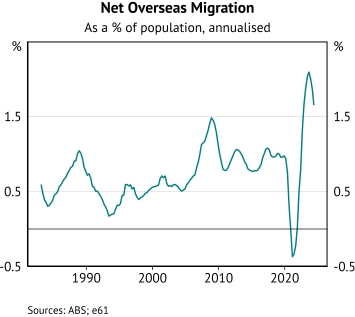
Immigration has become a major issue in many elections around the world, and ours is no exception. Following the reopening of borders post-COVID, Australia experienced record high net overseas migration. Today, both major parties are looking to slow immigration rates, potentially to below pre-COVID levels.
For decades, our population has grown faster than most peer countries. This growth has offered clear benefits like filling skill gaps and contributing to cultural diversity. However, this growth has come with challenges – our unique combination of a highly urbanised population with disproportionate levels of detached housing has contributed to our housing affordability crisis and put infrastructure under pressure.
With both major parties now seeking to moderate immigration, policymakers may need to find alternative ways to manage the issues immigration was helping to address, such as our ageing population.
Third, with potentially lower immigration and a changing global landscape, boosting productivity becomes our primary path to growth. Australia has had lacklustre productivity growth, and it has been costing Australians. Below-trend labour productivity since 2014 has come at a cost of around $11,000 in lost income per person, per year – this is arguably Australia’s ‘real’ cost-of-living crisis.
What’s driving this slowdown? Our report identifies signs of declining economic dynamism. Some are largely beyond the reach of policymakers—slower technological progress and an ageing population. But others are not—fewer new businesses entering markets and workers switching jobs less frequently. And, the rapid growth of the care sector, now Australia’s largest industry, where productivity gains are challenging, and often hard to measure, has also materially contributed to Australia’s productivity slowdown.
Fourth, restoring fiscal sustainability is now even more important to help us respond to global shocks and emerging priorities.
Despite a relatively low debt-to-GDP ratio by OECD standards, persistent deficits are projected for the next decade—and this does not account for the fiscal implications of a changing global order.
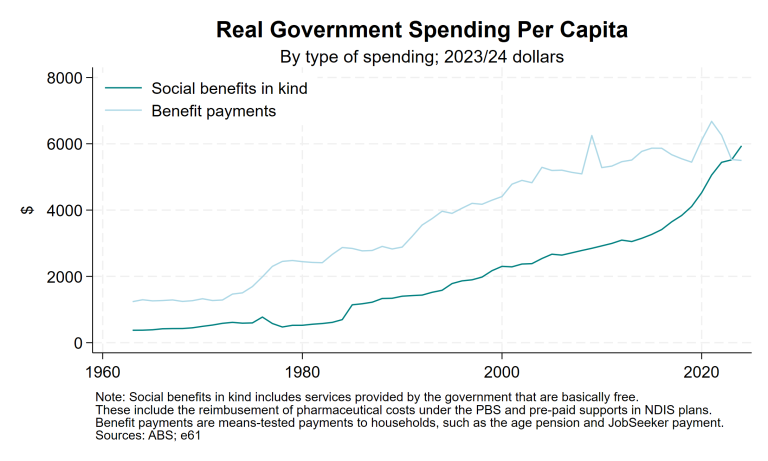
This trajectory is partially due to a change in the nature of government spending. Government spending is increasingly shifting from targeted transfer payments, like JobSeeker, to less means-tested in-kind benefits like aged care, childcare, and the National Disability Insurance Scheme. For the first time, spending on these in-kind benefits now exceeds traditional benefit payments. There’s no “Moore’s Law” for these in-kind benefits which means that not only are the demands on government larger, the prices government pays for those services are also growing rapidly.

Fifth, the combined effects of global fragmentation, productivity decline, and fiscal challenges threaten the compact between generations.
While young Australians continue to face housing affordability challenges, it is likely that they will enjoy higher living standards over their lifetimes than their parents and grandparents did. The critical difference may be one of timing and extent.
Today’s young Australians spend more time in education, face larger upfront housing costs, and contribute to superannuation at higher rates for longer periods. This potentially shifts their consumption from their liquidity-constrained younger years to later in life.
It is also possible that our fiscal deficits effectively tax some of that future consumption and transfer it to the present generation.
So, there is no guarantee. Without productivity improvements and fiscal sustainability, we risk breaking the promise that each generation will be better off than the last.
As Australians head to the polls shortly, our future depends on how the next Parliament will navigate these five challenges. The new e61-UNSW Policy Research Partnership—announced this week—aims to provide evidence to help policymakers navigate this increasingly complex and uncertain policy environment.
Stay tuned for more.

Michael Brennan
Michael Brennan is the CEO of the e61 Institute. He is an experienced economic policy professional, having been a former Chair of the Australian Productivity Commission and Deputy Secretary of the Australian Treasury. He has also worked as a Deputy Secretary in the Victorian Treasury, and as a consultant as well as an adviser to Federal and State Treasurers and Ministers for Finance.

Richard Holden
Richard Holden is Scientia Professor of Economics at UNSW Business School, President Emeritus of the Academy of the Social Sciences in Australia, Director of the Manos Innovation Lab in Education, and a weekly columnist at the Australian Financial Review. Prior to that he was on the faculty at the University of Chicago and the Massachusetts Institute of Technology. He received an AM and a PhD in economics from Harvard University. He is a fellow of the Econometric Society, the Academy of Social Sciences in Australia, and the Royal Society of New South Wales. His most recent books are Money in the Twenty-First Century: Cheap, Mobile, Digital (University of California Press), and Australia’s Pandemic Exceptionalism: How we crushed the curve but lost the race (UNSW Press).